
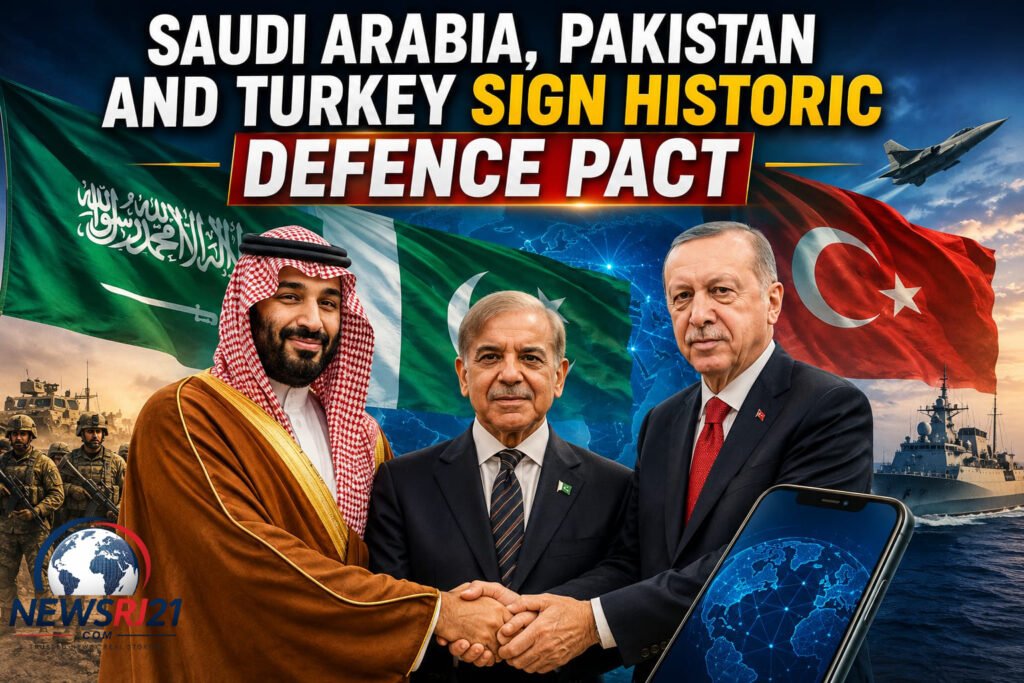
Saudi Arabia, Pakistan and Turkey have entered a new phase of defence cooperation with a landmark agreement aimed at strengthening their collective security. Signed in Mecca, the pact comes at a time of heightened regional tensions and growing concerns over security across the Middle East. Its most significant provision is clear: an armed attack on any one of the three countries will be treated as an attack on all three.
What Is the Historic Defence Pact Between Saudi Arabia, Pakistan and Turkey?
Saudi Arabia, Pakistan and Turkey have entered a new phase of strategic cooperation through a defence agreement designed to strengthen their collective security. The pact was signed in Mecca as regional tensions remain high, giving the Saudi Arabia-Pakistan-Turkey defence pact wider geopolitical significance beyond the three countries themselves.
The agreement establishes a mutual-defence principle under which an armed attack against any one of the three countries is to be treated as an attack against all three. That provision gives the defence pact its strongest strategic dimension, although the agreement does not publicly spell out every military response that would follow such an attack.
For Saudi Arabia, the deal adds another layer to its security partnerships at a time when instability across the Middle East has increased concerns about regional defence. Pakistan brings extensive military experience and an established security relationship with Riyadh, while Turkey adds another major regional military power with growing defence capabilities.
The defence pact should therefore be viewed as a significant framework for closer security cooperation rather than automatically described as a NATO-style alliance. Its long-term importance will depend on how the three countries translate the agreement into practical cooperation, including defence planning, coordination and future security initiatives.
Why Have Saudi Arabia, Pakistan and Turkey Signed the Pact Now?
The timing of the Saudi Arabia, Pakistan and Turkey defence pact is central to understanding its significance. The agreement comes as security tensions across the Middle East have intensified, with Saudi Arabia facing concerns about possible attacks from Iran-aligned forces and wider threats to critical infrastructure. Reuters reported on August 6 that Riyadh was anticipating potential attacks from Iranian-backed groups.
For Saudi Arabia, the new defence pact provides another layer of security at a particularly sensitive moment. The kingdom has been working to protect its territory, energy infrastructure and key transport routes while also pursuing diplomatic efforts to prevent the regional conflict from spreading.
Pakistan already has deep military ties with Saudi Arabia. Earlier this year, Islamabad deployed thousands of troops, fighter aircraft and air-defence equipment to the kingdom under its existing mutual-defence arrangement. The new defence pact therefore builds on an established security relationship rather than creating cooperation from scratch.
Turkey adds another important dimension. Ankara has its own extensive military capabilities and longstanding strategic relationships across the region. Bringing Turkey into the arrangement gives the defence pact a broader regional character and connects the security interests of the Gulf, South Asia and Türkiye.
The agreement also reflects a wider desire among the three countries to strengthen their ability to respond to regional threats without relying entirely on outside security guarantees. Reuters described the pact as a move toward greater regional security cooperation amid the escalating conflict.
Importantly, the three countries have presented the defence pact as defensive rather than an agreement aimed at a specific country. Its immediate purpose is therefore deterrence: making potential adversaries think carefully about the consequences of attacking any one of the three partners. That combination of heightened regional insecurity, existing military ties and a push for stronger collective deterrence explains why the agreement has emerged at this particular moment.
Why Is Turkey’s Involvement Strategically Important?
Turkey’s participation gives the Saudi Arabia, Pakistan and Turkey defence pact a wider strategic dimension. Ankara is already an influential military power in the region, with a sizeable armed force, an expanding defence industry and longstanding security relationships across the Middle East. Its involvement therefore adds more than another diplomatic partner to the agreement.
For Saudi Arabia, closer defence cooperation with Turkey could broaden its options as Riyadh seeks to strengthen its ability to respond to regional security threats. Turkey has developed significant capabilities in areas including unmanned systems, air defence and military technology, although the new defence pact does not publicly establish specific weapons or procurement commitments between the three countries.
Turkey also has a distinctive position in regional diplomacy. It maintains relationships with countries across the Middle East, Europe and Asia, giving Ankara a potentially useful role in wider security discussions. Its participation alongside Pakistan creates a partnership that connects two major non-Arab military powers with Saudi Arabia.
The defence pact could also encourage greater defence cooperation in training, military exercises, intelligence sharing and technology. However, these possibilities should not be confused with confirmed commitments. The agreement’s publicly available details do not establish a complete military command structure or automatic deployment of forces.
For Turkey, the arrangement strengthens its ties with Saudi Arabia and Pakistan at a time when regional security relationships are being reshaped. For Riyadh and Islamabad, Ankara’s participation adds another major strategic partner to an already significant defence network.
That makes Turkey’s role particularly important: the defence pact brings together three countries with different military strengths, geographic positions and strategic interests, potentially creating a more closely connected security partnership across the region.
What Does the Agreement Mean for Saudi Arabia’s Security?
For Saudi Arabia, the new Saudi Arabia, Pakistan and Turkey defence pact adds another layer to its security strategy at a time of heightened regional uncertainty. Riyadh has faced growing concerns over missile threats, attacks on critical infrastructure and the possibility of wider conflict spreading across the Middle East.
The defence pact strengthens Saudi Arabia’s security links with two countries that have significant military capabilities. Pakistan has longstanding defence ties with the kingdom, while Turkey brings its own advanced military industry and regional experience. Together, the arrangement gives Riyadh additional strategic relationships beyond its traditional security partnerships.
The timing is particularly important. Saudi Arabia has increasingly sought to strengthen its ability to protect key economic assets, energy infrastructure and strategic territory. A formal commitment from Pakistan and Turkey could contribute to deterrence by raising the potential cost of any attack against the kingdom.
However, the defence pact should not be viewed as a replacement for Saudi Arabia’s existing international security relationships. Riyadh continues to maintain important ties with the United States and other partners, meaning the new agreement is more likely to complement its wider defence strategy than replace it.
The pact could also encourage deeper cooperation in areas such as military training, intelligence, defence technology and joint exercises. Whether those ambitions become formal programmes will depend on decisions taken by the three governments in the months ahead.
For Saudi Arabia, the immediate value of the defence pact is therefore deterrence and strategic flexibility. It signals that the kingdom is seeking to broaden its security partnerships while preparing for a regional environment in which threats can change quickly.
Is This a NATO-Style Military Alliance?
The Saudi Arabia, Pakistan and Turkey defence pact has drawn comparisons with NATO because of its collective-defence principle. The agreement says that an armed attack on one of the three countries will be treated as an attack on all three, creating a clear deterrence message.
However, calling it a NATO-style alliance would go further than the available details support. NATO has a permanent institutional structure, established command arrangements, integrated military planning and decades of operational cooperation. The new defence pact does not currently provide the same level of publicly defined military infrastructure.
That distinction matters. The agreement establishes a shared security commitment, but it does not automatically mean that Saudi Arabia, Pakistan and Turkey will operate as a single military force. The response to any future attack would depend on the circumstances and decisions taken by the three governments.
The defence pact is better understood at this stage as a strategic mutual-defence framework. Its importance will depend on what happens after the signing, including whether the countries establish regular military exercises, intelligence-sharing mechanisms, joint planning or other forms of defence coordination.
The comparison with NATO is therefore useful for explaining the pact’s collective-security principle, but it should not be treated as evidence that a new NATO-like military organisation has already been created.
For now, the defence pact represents a significant political and security commitment between three countries, while its practical military structure remains something to watch as cooperation develops.
How Could the Pact Change the Middle East’s Security Balance?
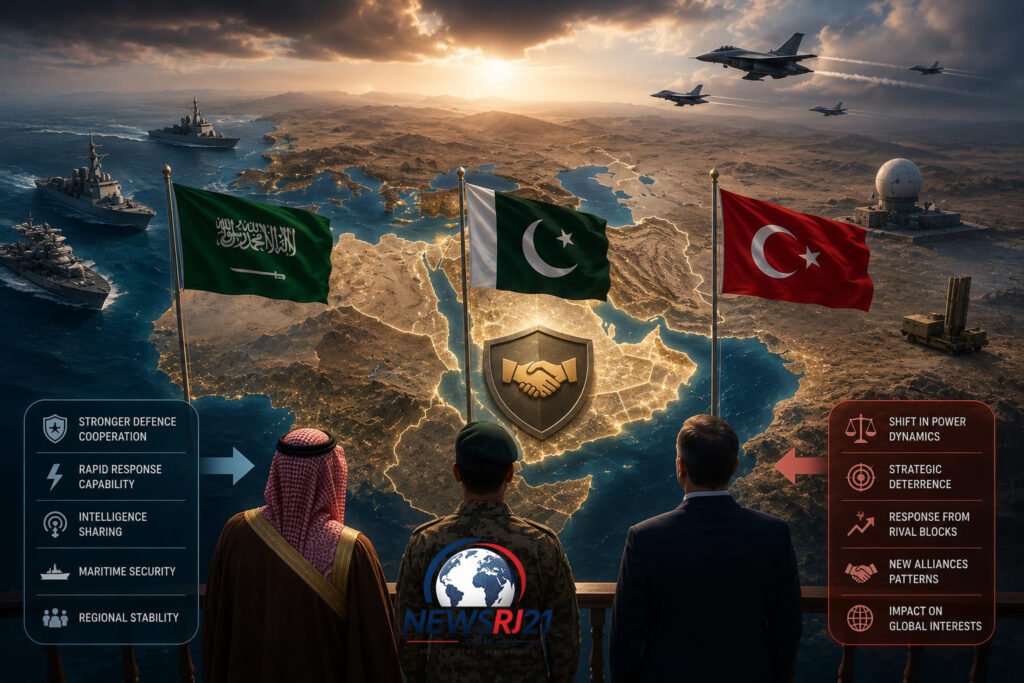
The Saudi Arabia, Pakistan and Turkey defence pact could become an important new element in the Middle East’s evolving security landscape. By linking Saudi Arabia with two major military powers from South Asia and the wider region, the agreement creates a partnership that stretches beyond traditional Gulf security arrangements.
Its most immediate effect could be deterrence. If potential adversaries believe that an attack on Saudi Arabia could trigger support from Pakistan and Turkey, the political and military calculations surrounding any future confrontation may become more complicated. The defence pact therefore gives Riyadh an additional tool for discouraging attacks without necessarily requiring immediate military action.
The agreement could also encourage greater defence coordination. Over time, the three countries may explore joint exercises, intelligence cooperation, military training and closer coordination on defence technology. Any such developments would give the defence pact greater practical significance.
There is also a broader geopolitical dimension. Saudi Arabia has important relationships with the United States and other Western partners, while Turkey is a NATO member and Pakistan has its own long-standing security relationships. The new defence pact does not automatically replace these partnerships, but it could give all three countries greater room to pursue a more diversified security strategy.
The impact on regional diplomacy will depend heavily on how the agreement develops. If it remains primarily a political commitment, its effect may be limited to deterrence and closer diplomatic coordination. If it develops into regular military cooperation, however, it could have a much more visible influence on the region’s balance of power.
What Could the Defence Pact Mean for India?
The Saudi Arabia, Pakistan and Turkey defence pact is likely to attract close attention in India because Pakistan is one of the three signatories. However, the agreement should not automatically be interpreted as a direct security threat to India.
The pact is presented as a collective-defence arrangement between Saudi Arabia, Pakistan and Turkey. Its stated focus is protecting the three members from armed attacks, rather than targeting another country. There is also no publicly established provision in the defence pact that identifies India as a potential adversary.
For India, the most important issue will be how the agreement develops in practice. If cooperation remains focused on regional security, training and defence coordination, its impact on New Delhi may be limited. If the partnership expands into deeper military planning involving Pakistan, India would naturally monitor those developments more closely.
Saudi Arabia’s relationship with India is another important factor. New Delhi and Riyadh have extensive economic, energy and diplomatic ties, so India has an interest in maintaining a stable relationship with the kingdom even as Riyadh strengthens its defence partnerships.
Turkey’s involvement also adds a separate dimension. Ankara and New Delhi have maintained diplomatic and economic relations, although their positions on several regional issues have sometimes differed. The defence pact could therefore become another development that India watches as it assesses the changing strategic balance around West Asia.
It is important not to overstate the immediate consequences. The agreement does not mean that Saudi Arabia, Pakistan and Turkey have formed a military bloc against India. Its real significance for New Delhi will depend on the military and diplomatic arrangements that emerge after the signing.
For now, India’s most likely approach will be careful observation, while continuing its established relationships with Saudi Arabia, Turkey and other key partners across the region.
How Could the Agreement Affect US and Regional Relations?
The Saudi Arabia, Pakistan and Turkey defence pact could also influence the wider network of security partnerships involving the United States and other major powers. Saudi Arabia remains an important US security and economic partner, while Turkey is a NATO member and Pakistan has its own long-standing relationship with Washington.
The new defence pact does not mean Saudi Arabia is turning away from the United States. Riyadh has repeatedly maintained relationships with multiple international partners, and closer cooperation with Pakistan and Turkey can be viewed as part of that broader strategy of diversifying security ties.
For Washington, the key question will be how the three countries translate their agreement into practical military cooperation. A partnership focused on deterrence, training and regional stability may be viewed differently from one that develops into a formal military structure with deeper operational coordination.
The defence pact could also affect the calculations of other regional powers. Stronger defence links between the Gulf, South Asia and Türkiye may encourage neighbouring states to reassess their own security partnerships and diplomatic strategies.
At the same time, the agreement could create opportunities for greater regional coordination. If the three countries use the defence pact to improve communication, crisis management and cooperation against common security threats, it could contribute to wider stability rather than simply deepen military competition.
What Happens Next After the Defence Pact?
The signing of the Saudi Arabia, Pakistan and Turkey defence pact is only the first step. Its real importance will become clearer as the three governments decide how the agreement will work in practice and whether the political commitment develops into deeper military cooperation.
One area to watch is defence coordination. The three countries could explore closer communication between their armed forces, joint training, intelligence cooperation and military exercises. If these measures are introduced, the defence pact would gain a more practical dimension beyond its current political and strategic significance.
The governments may also need to clarify how the collective-defence provision would operate during a crisis. An attack on one member is to be treated as an attack on all three, but the agreement’s publicly available details do not establish a single automatic military response. Future arrangements could provide greater clarity on how decisions would be made.
The defence pact could also lead to more regular consultations between the three countries on regional security. That could include discussions over threats to critical infrastructure, maritime security, air defence and wider regional stability.
Much will depend on whether the agreement remains primarily a deterrence mechanism or develops into a broader institutional partnership. Either way, the pact has already signalled a stronger strategic relationship between Riyadh, Islamabad and Ankara.
For the defence pact, the next phase will therefore be crucial. Concrete military cooperation, new security mechanisms or additional agreements would show that the partnership is becoming more deeply embedded in the region’s security architecture.
Key Takeaways From the Saudi Arabia, Pakistan and Turkey Defence Pact
The Saudi Arabia, Pakistan and Turkey defence pact marks a significant step in security cooperation between the three countries, but its long-term importance will depend on how the agreement is implemented.
- Collective defence is at the centre: An armed attack on one member is to be treated as an attack on all three.
- Saudi Arabia gains another security partnership: The agreement adds Pakistan and Turkey to Riyadh’s wider network of strategic defence relationships.
- Pakistan brings established military ties: Islamabad already has a longstanding defence relationship with Saudi Arabia.
- Turkey broadens the partnership: Ankara’s military capabilities and regional influence give the defence pact a wider strategic dimension.
- It is not automatically a NATO-style alliance: The agreement does not publicly establish NATO’s type of permanent command structure or integrated military system.
- Iran will be watching closely: The pact could influence Tehran’s assessment of the changing regional security balance, although the agreement does not name Iran as a target.
- India is likely to monitor developments: Pakistan’s involvement makes the agreement relevant to New Delhi, but there is no basis for describing it as an anti-India alliance.
- The next phase will matter most: Future military exercises, intelligence cooperation, defence planning and other practical arrangements will determine how significant the defence pact ultimately becomes.
Overall, the agreement sends a clear message of closer strategic alignment while leaving important questions about its practical military implementation still to be answered.
Frequently Asked Questions About the Saudi Arabia, Pakistan and Turkey Defence Pact
1. What is the Saudi Arabia, Pakistan and Turkey defence pact?
It is a mutual-defence agreement signed by Saudi Arabia, Pakistan and Turkey to strengthen cooperation and collective security. Its central provision treats an armed attack against one member as an attack against all three.
2. Is the defence pact similar to NATO?
The defence pact has a collective-defence principle that is comparable in concept to NATO’s Article 5. However, it does not currently have NATO’s permanent command structure, integrated military system or institutional framework.
3. Is the agreement directed against Iran?
The three countries have presented the defence pact as a defensive arrangement and have not publicly identified Iran as its target. Its broader regional impact will depend on how the agreement is implemented.
4. What does the pact mean for India?
India is likely to monitor the agreement because Pakistan is one of the signatories. However, there is no basis to describe the Saudi Arabia Pakistan Turkey defence pact as an anti-India alliance. Its stated purpose is collective security among the three members.
5. What happens after the defence pact is signed?
The next step will be practical implementation. Military exercises, intelligence cooperation, defence planning and other security arrangements could determine how significant the defence pact becomes over time.
Conclusion: A Significant New Defence Partnership With Wider Regional Implications
The defence pact marks a notable expansion of security cooperation between three strategically important countries. Its collective-defence provision sends a strong deterrence message while giving Saudi Arabia, Pakistan and Turkey a more formal framework for closer security coordination.
The agreement also comes at a sensitive moment for the region, making its timing particularly significant. However, it would be premature to describe the defence pact as a fully developed NATO-style military alliance. Its long-term importance will depend on the practical steps that follow, including military coordination, intelligence sharing, exercises and future security arrangements.
For now, the defence pact represents a clear political commitment to stand together against armed threats. How effectively that commitment translates into practical cooperation could determine whether the agreement becomes a lasting feature of the region’s changing security landscape.
Reliable Sources
- Saudi Arabia, Turkey, Pakistan pledge mutual defence as Middle East turmoil escalates
- Saudi Arabia, Pakistan and Turkey sign Nato-style defence pact amid deadly Houthi strikes in Yemen
Related Article
- 5 Key Reasons UEFA Is Still Threatening to Boycott the FIFA World Cup Over Gianni Infantino
- SpaceX Falcon 9 Rocket Crashes Into the Moon, Giving Scientists a Rare Chance to Study a Lunar Impact