
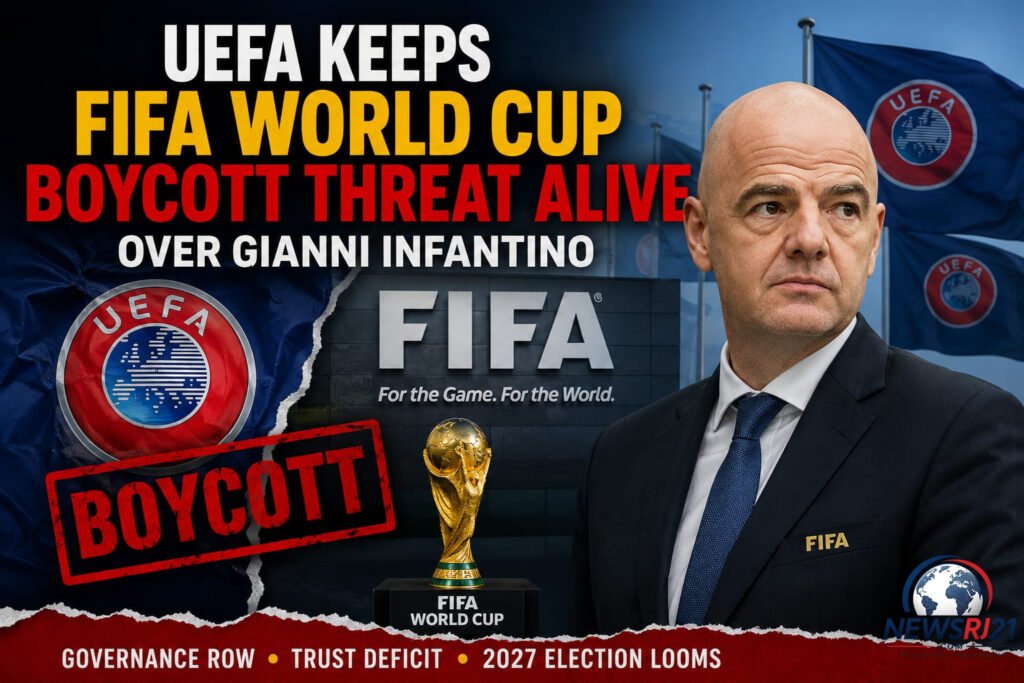
A growing rift between UEFA and FIFA has escalated into one of the most significant governance disputes in world football, with Europe’s governing body refusing to withdraw its threat of boycotting future FIFA competitions. The standoff comes despite FIFA’s public support for President Gianni Infantino and the withdrawal of a controversial proposal to bring private investors into the commercial management of its flagship tournaments. UEFA FIFA World Cup Boycott.
UEFA insists the core issues extend beyond the abandoned plan itself, arguing that trust in FIFA’s leadership has been seriously damaged by a lack of transparency and consultation. As pressure builds ahead of the next FIFA presidential election, the dispute is raising fresh questions about accountability, the future governance of global football, and whether one of the sport’s deepest divisions could reshape international competitions in the years ahead.
Why Is UEFA Still Threatening a FIFA World Cup Boycott?
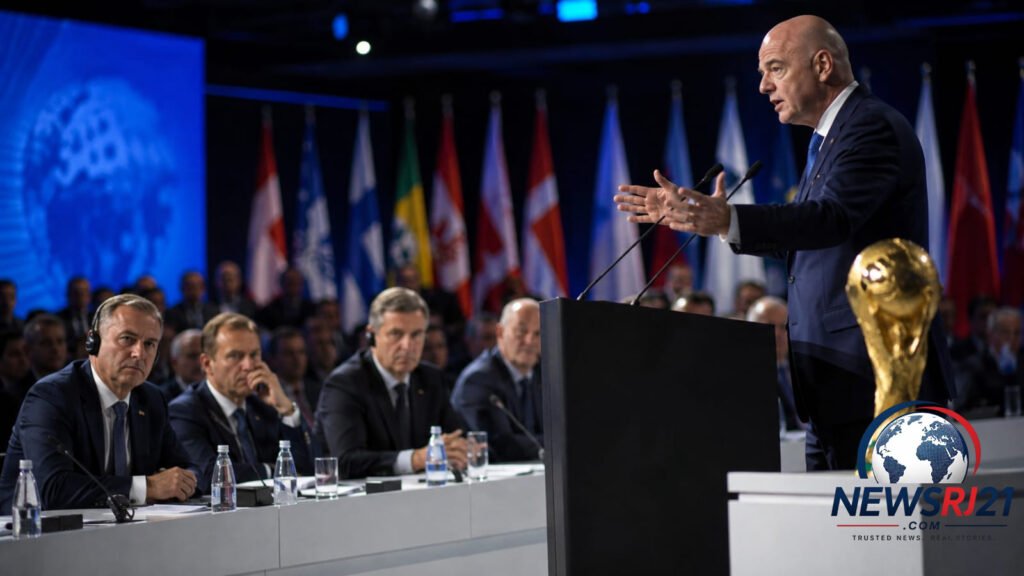
UEFA says its concerns were not resolved simply because FIFA abandoned the controversial FIFA Forward Enterprise (FFE) proposal. According to the European governing body, the issue is no longer limited to a single commercial plan but extends to broader questions about governance, transparency, and trust within world football’s governing organization.
In its latest statement, UEFA reiterated that two conditions had been set before it would reconsider its position. First, the proposal to involve private investors in FIFA’s major competitions had to be permanently withdrawn. Second, FIFA needed to provide clear assurances that similar initiatives would not be pursued in the future without proper consultation and oversight.
While FIFA has confirmed that the proposal will not move forward, UEFA maintains that the second condition has not been met. It also says its loss of confidence in FIFA President Gianni Infantino remains unchanged, arguing that the recent statement issued by FIFA does not adequately address the concerns raised by its member associations. UEFA FIFA World Cup Boycott.
As a result, UEFA continues to keep the possibility of boycotting future FIFA competitions, including the World Cup, on the table, signaling that the dispute over FIFA’s leadership and decision-making process is far from over.
What Is the FIFA Forward Enterprise Controversy?
The current dispute centers on the now-abandoned FIFA Forward Enterprise (FFE) proposal, a plan that would have transferred commercial interests in some of FIFA’s most valuable competitions to private investors. The proposal immediately sparked criticism from several football associations, with opponents arguing that it had been developed without sufficient consultation or transparency.
According to UEFA, the proposal represented a significant shift in how FIFA manages its flagship tournaments, including the FIFA World Cup. European football leaders said decisions of this scale should involve broader discussion with member associations rather than being presented as a largely completed plan. UEFA FIFA World Cup Boycott.
The controversy intensified after reports suggested that senior figures within FIFA had not been fully informed before the proposal emerged. Critics also questioned the governance process behind the initiative, arguing that major commercial decisions affecting global football require greater oversight and accountability.
Although FIFA later confirmed that the FIFA Forward Enterprise proposal would not proceed, UEFA maintains that withdrawing the plan alone is not enough. The organization says FIFA must also introduce stronger safeguards to ensure that similar proposals cannot be developed without proper consultation in the future.
For many within European football, the controversy has become less about a single business proposal and more about how FIFA is governed. That broader concern continues to fuel the growing pressure on Gianni Infantino as the next FIFA presidential election approaches.
Why Is Gianni Infantino Facing Growing Pressure?
The controversy has placed Gianni Infantino under some of the strongest pressure of his presidency, with several European football associations openly questioning his leadership. Critics argue that the issue extends beyond the abandoned FIFA Forward Enterprise (FFE) proposal and reflects deeper concerns about how FIFA makes major commercial and governance decisions. UEFA FIFA World Cup Boycott.
Within UEFA, there is a growing belief that Gianni Infantino should have accepted personal responsibility for the failed proposal instead of issuing a joint expression of regret with FIFA Secretary General Mattias Grafström. Some European officials also believe the apology did not adequately address the concerns raised by member associations or restore confidence in FIFA’s decision-making process.
The criticism has also reached inside FIFA. Carlos Cordeiro, one of Gianni Infantino’s senior advisers on global strategy and governance, resigned following the controversy. While other senior officials have remained in their positions, the episode has intensified debate over whether FIFA needs stronger internal oversight and greater transparency when considering significant commercial initiatives.
Despite mounting criticism across Europe, Gianni Infantino continues to retain substantial support from many national football associations outside the continent. That global backing could prove crucial as attention turns to the next FIFA presidential election, where his leadership is expected to face renewed scrutiny but remains far from politically isolated.
Could UEFA Really Boycott the FIFA World Cup?
Although a FIFA World Cup boycott has not been confirmed, UEFA has made it clear that the option remains under consideration if its concerns about FIFA’s governance are not addressed. The governing body says its confidence in Gianni Infantino’s leadership has not been restored, despite FIFA’s decision to withdraw the controversial commercial proposal.
A boycott would require significant coordination among UEFA’s member associations, many of which are among the strongest football nations in the world. Under FIFA’s statutes, UEFA could also seek an extraordinary FIFA Congress by gathering enough support from member associations to trigger a vote of no confidence. However, removing a FIFA president would require backing from a majority of FIFA’s 211 member associations, making the process politically complex. UEFA FIFA World Cup Boycott.
At present, football officials believe Gianni Infantino continues to enjoy considerable support outside Europe, particularly among national associations that have benefited from the FIFA Forward funding programme. That global backing could make it difficult for UEFA to secure enough votes to force a leadership change, even if dissatisfaction continues to grow within European football.
For now, the possibility of a FIFA World Cup boycott remains a powerful negotiating tool rather than an immediate outcome. Nevertheless, the ongoing dispute has exposed one of the deepest divisions between UEFA and FIFA in recent years and could have a lasting impact on the governance of international football ahead of the 2027 FIFA presidential election.
What Happens Next for FIFA and Gianni Infantino?
The next major test for FIFA and Gianni Infantino will come as preparations begin for the 2027 FIFA presidential election. Although several European football associations have withdrawn their support for Infantino, he is still widely expected to seek another term and continues to enjoy significant backing from many FIFA member associations outside Europe.
Attention is also turning to FIFA’s next funding model. The current FIFA Forward programme, which provides financial support to national football associations and continental confederations, expires at the end of 2026. Any new funding proposal is likely to play a key role in shaping political support ahead of the election, particularly among smaller football nations that rely heavily on FIFA development grants.
Meanwhile, UEFA has not ruled out pursuing further action if it believes meaningful governance reforms are not introduced. European officials continue to argue that FIFA needs stronger checks and balances, greater transparency, and a more consultative decision-making process to rebuild trust after the FIFA Forward Enterprise (FFE) controversy. UEFA FIFA World Cup Boycott.
For Gianni Infantino, the coming months could prove decisive. His ability to restore confidence within FIFA, respond to governance concerns, and maintain international support will likely determine whether he enters the next presidential election as the clear favorite or faces his strongest leadership challenge since taking office in 2016.
What Reforms Could FIFA Introduce to Restore Trust?
The growing dispute has intensified calls for FIFA to strengthen its governance framework and rebuild confidence among its member associations. Football administrators across Europe argue that the controversy surrounding the FIFA Forward Enterprise (FFE) proposal exposed weaknesses in how major commercial decisions are developed and presented within FIFA. UEFA FIFA World Cup Boycott.
One of the most widely discussed reforms is the introduction of stronger oversight before significant commercial agreements are considered. Critics believe future proposals should undergo broader consultation with continental confederations and national football associations, ensuring that key stakeholders have an opportunity to review and challenge major decisions before they are approved.
There have also been calls for FIFA to improve transparency by providing clearer information about strategic projects, financial partnerships, and governance processes. Supporters of reform argue that greater openness would help restore trust, reduce internal disputes, and strengthen confidence in FIFA’s leadership ahead of future global tournaments.
For Gianni Infantino, implementing meaningful governance reforms could become an important step toward easing tensions with UEFA and other critics. Whether FIFA chooses to introduce additional safeguards or maintain its current approach may significantly influence relations between the world’s governing body and its member associations in the years leading up to the next FIFA presidential election.
Could Gianni Infantino Face a Serious Challenge in the Next FIFA Election?
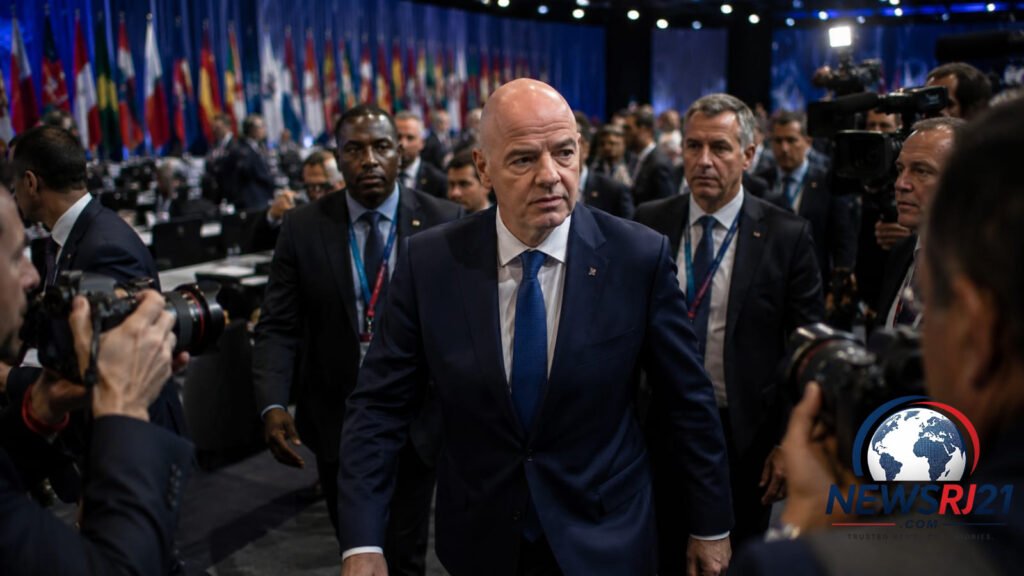
Although Gianni Infantino remains the favorite to seek another term as FIFA president, the current controversy has created the most significant political challenge of his leadership in recent years. Several European football associations, including members of UEFA, have publicly withdrawn their support, increasing pressure ahead of the 2027 FIFA presidential election. UEFA FIFA World Cup Boycott.
Under FIFA’s electoral rules, any presidential candidate must secure the support of at least 106 of FIFA’s 211 member associations to win the election. While UEFA has expressed a loss of confidence in Gianni Infantino, football analysts believe he continues to enjoy broad backing from national associations across Africa, Asia, the Americas, and Oceania, where the FIFA Forward programme has funded football development projects for years.
The coming months will also determine whether a credible rival emerges. Candidates have until the official nomination deadline to challenge Gianni Infantino, who previously ran unopposed in the 2019 and 2023 presidential elections. If a strong alternative candidate gains support from multiple confederations, the next election could become the most competitive FIFA leadership contest in more than a decade.
For now, Gianni Infantino’s political future remains closely tied to how FIFA responds to demands for greater transparency and governance reform. While his global support base remains substantial, the ongoing dispute with UEFA has ensured that the next FIFA presidential election will be watched more closely than any in recent memory.
What Could This Mean for the Future of International Football?
The ongoing dispute between UEFA and FIFA extends far beyond a single governance controversy. Football analysts believe the outcome could influence how FIFA manages major competitions, commercial partnerships, and relationships with its member associations for years to come. As the governing body responsible for the FIFA World Cup and other global tournaments, FIFA’s credibility remains central to the stability of international football.
If tensions continue, the disagreement could make cooperation between FIFA and UEFA more difficult on issues ranging from tournament scheduling to commercial strategy and governance reforms. Although both organizations share responsibility for developing the global game, the current standoff has highlighted significant differences over transparency, consultation, and institutional accountability.
The controversy may also encourage other football associations to demand a greater role in FIFA’s decision-making process. Calls for stronger governance, improved financial oversight, and more inclusive leadership have grown louder following the FIFA Forward Enterprise (FFE) proposal, suggesting that future policy decisions could face closer scrutiny than ever before. UEFA FIFA World Cup Boycott.
While a FIFA World Cup boycott remains only a possibility, the political consequences of this dispute are already being felt across world football. Whether FIFA succeeds in rebuilding trust with UEFA and other stakeholders could shape the future governance of the sport and influence the direction of international football well beyond the next presidential election.
Why This FIFA-UEFA Dispute Matters Beyond Football
The current disagreement between FIFA and UEFA is about far more than a single commercial proposal. It has evolved into a broader debate over how the world’s most influential football organization should be governed, how major decisions should be made, and how accountable FIFA’s leadership should be to its member associations.
For supporters, players, sponsors, broadcasters, and national football associations, the stability of FIFA is essential to the smooth operation of international competitions, including the FIFA World Cup. Any prolonged dispute between FIFA and UEFA has the potential to influence future tournament planning, commercial partnerships, governance reforms, and confidence in football’s global administration.
Although a FIFA World Cup boycott remains only a possibility, the controversy has already exposed significant divisions within international football. It has also intensified scrutiny of Gianni Infantino’s leadership at a time when FIFA is preparing for another presidential election and expanding its global competitions. UEFA FIFA World Cup Boycott.
Whether the two governing bodies ultimately find common ground or continue on separate paths, the outcome of this dispute is likely to shape the future of FIFA, UEFA, and international football governance for years to come. For that reason, this is not simply another administrative disagreement—it is one of the most consequential leadership challenges facing world football today.
What Could UEFA Do Next in Its Dispute With FIFA?
Despite FIFA’s decision to abandon the controversial commercial proposal, UEFA has indicated that its concerns remain unresolved. European football officials continue to argue that rebuilding trust will require more than withdrawing a single initiative, placing the focus on what steps UEFA could take if meaningful governance reforms do not follow.
One option available to UEFA is to continue lobbying other FIFA member associations for broader institutional reform. UEFA also retains the ability to push for an extraordinary FIFA Congress if it can gather sufficient support under FIFA’s statutes. Such a move could open the door to formal debates over governance, transparency, and confidence in FIFA’s leadership. UEFA FIFA World Cup Boycott.
At the same time, UEFA is expected to keep diplomatic channels open while monitoring how FIFA responds in the months ahead. Football governance experts believe both organizations have strong incentives to avoid a prolonged confrontation, particularly with major international tournaments approaching and preparations already underway for future FIFA World Cup competitions.
For now, neither UEFA nor FIFA appears willing to completely back away from its position. Whether the dispute leads to compromise, governance reform, or a deeper political divide will depend on the willingness of both organizations to rebuild trust before the next FIFA presidential election and the future of international football governance.
Who Is Gianni Infantino? A Brief History of the FIFA President
Gianni Infantino is a Swiss-Italian football administrator who has served as FIFA President since February 2016. Before taking charge of FIFA, he spent more than a decade at UEFA, where he held several senior leadership positions, including General Secretary. During his time at UEFA, Gianni Infantino became known for overseeing major European club and national team competitions while helping expand the organization’s commercial and regulatory operations. UEFA FIFA World Cup Boycott.
After being elected FIFA President following one of the most turbulent periods in the organization’s history, Gianni Infantino promised to improve governance, strengthen financial transparency, and expand investment in football development. Under his leadership, FIFA launched successive versions of the FIFA Forward programme, increasing financial support for national football associations and confederations around the world.
His presidency has also been marked by ambitious changes to international football. FIFA approved the expansion of the FIFA World Cup, introduced larger global club competitions, and pursued new commercial opportunities aimed at increasing football’s worldwide reach. While supporters argue these initiatives have accelerated the sport’s global growth, critics have questioned several governance decisions and the level of consultation behind major policy changes.
The latest dispute with UEFA over the FIFA Forward Enterprise (FFE) proposal represents one of the most significant political challenges of Gianni Infantino’s tenure. As FIFA prepares for its next presidential election, his leadership, governance record, and vision for the future of world football are expected to remain at the center of international debate.
Frequently Asked Questions (FAQs)
1. Why is UEFA threatening to boycott the FIFA World Cup?
UEFA says it has lost confidence in FIFA President Gianni Infantino following the controversial FIFA Forward Enterprise (FFE) proposal. Although the proposal has been withdrawn, UEFA believes FIFA has not provided sufficient assurances that similar governance issues will not happen again, leaving the possibility of a FIFA World Cup boycott open.
2. What was the FIFA Forward Enterprise (FFE) proposal?
The FIFA Forward Enterprise (FFE) proposal was a commercial initiative that would have involved private investors in managing the business interests of major FIFA competitions. The proposal was later abandoned after criticism from UEFA and several football associations over concerns about transparency and governance.
3. Could European teams actually boycott the FIFA World Cup?
At present, no FIFA World Cup boycott has been confirmed. However, UEFA has stated that the option remains available if its governance concerns are not addressed. Any boycott would require significant coordination among European football associations and would have major implications for international football.
4. Why is Gianni Infantino facing criticism?
Gianni Infantino is facing criticism because opponents believe the FIFA Forward Enterprise (FFE) proposal was developed without adequate consultation or transparency. Several European football associations argue that FIFA should strengthen its governance framework and improve accountability before confidence can be restored.
5. When is the next FIFA presidential election?
The next FIFA presidential election is scheduled to take place during the FIFA Congress in Morocco in March 2027. Gianni Infantino is widely expected to seek another term, although potential challengers can still enter the race before the official nomination deadline.
Key Takeaways
- UEFA has reaffirmed that it has not regained confidence in FIFA President Gianni Infantino, despite FIFA withdrawing the controversial FIFA Forward Enterprise (FFE) proposal.
- The dispute centers on concerns over FIFA’s governance, transparency, and decision-making process, rather than the commercial proposal alone.
- UEFA says its conditions for restoring trust have not been fully met, leaving the possibility of a FIFA World Cup boycott on the table.
- Although Gianni Infantino faces increasing criticism in Europe, he continues to enjoy significant support from many FIFA member associations outside the continent. UEFA FIFA World Cup Boycott.
- The 2027 FIFA presidential election is expected to become a crucial test of Gianni Infantino’s leadership as questions over governance and accountability continue to dominate global football.
- Football governance experts believe FIFA may need to introduce stronger oversight, greater transparency, and broader consultation to rebuild confidence among its member associations.
- For now, no FIFA World Cup boycott has been confirmed, but the ongoing dispute between FIFA and UEFA remains one of the most significant political challenges facing international football.
Reliable Sources
The information in this article is based on official statements and reporting from trusted football governing bodies and internationally recognized news organizations.
Related Articles
- FIFA Scraps Controversial World Cup Investment Plan After Global Backlash
- SpaceX Falcon 9 Rocket Crashes Into the Moon, Giving Scientists a Rare Chance to Study a Lunar Impact
Conclusion
The confrontation between FIFA and UEFA has developed into one of the most significant governance disputes in modern football. While the controversial FIFA Forward Enterprise (FFE) proposal has been withdrawn, the underlying issues of transparency, accountability, and trust remain unresolved. As a result, UEFA continues to keep the possibility of a FIFA World Cup boycott on the table, maintaining pressure on Gianni Infantino and FIFA’s leadership.
With the 2027 FIFA presidential election approaching, the coming months are likely to be crucial for FIFA. Whether the organization introduces meaningful governance reforms, rebuilds confidence among its member associations, or faces continued opposition from UEFA could shape the future of international football for years to come. UEFA FIFA World Cup Boycott.
For now, no boycott has been confirmed, and discussions between football’s governing bodies are expected to continue. However, the dispute has already highlighted the growing importance of transparency and shared decision-making within FIFA, ensuring that this story will remain one of the defining issues in global football governance.