
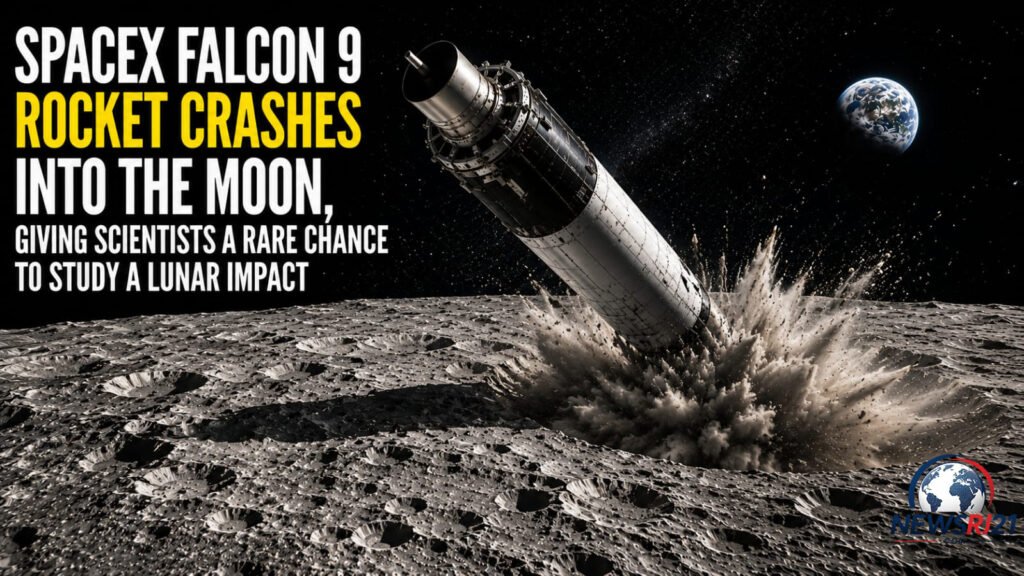
A discarded SpaceX Falcon 9 rocket stage has crashed into the Moon in a rare event that scientists say could unlock valuable insights into the lunar surface. The impact, which occurred near Einstein Crater, poses no threat to Earth but offers researchers a unique opportunity to study a lunar collision with an object whose size, speed, and trajectory were already known.
As space agencies prepare for more missions to the Moon, the incident has also renewed attention on the growing challenge of space debris and protecting the lunar environment for future exploration.
What Happened to the SpaceX Falcon 9 Rocket?
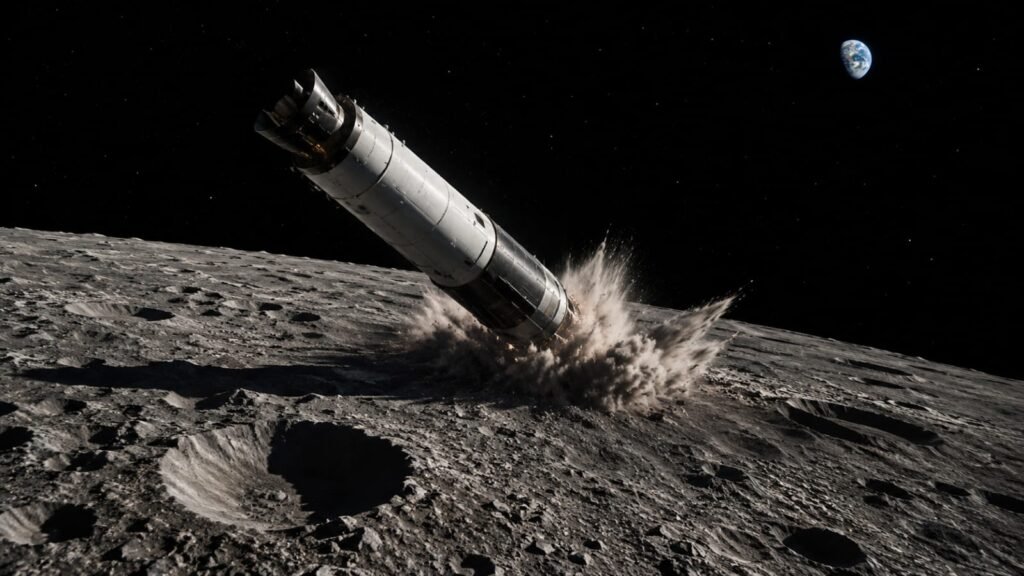
A SpaceX Falcon 9 upper-stage rocket crashed into the Moon after spending months drifting through space following its 2025 launch. According to NASA, the discarded rocket stage struck the lunar surface near Einstein Crater at a speed of approximately 2.43 kilometers per second (about 5,400 mph).
The impact occurred after independent astronomers tracked the rocket’s trajectory and determined that it had entered an accidental collision course with the Moon. Unlike a planned mission, the rocket stage was no longer under active control, making the collision an unintended but scientifically valuable event.
Although the impact created a new crater and a large cloud of lunar dust, experts emphasized that it posed no danger to Earth. Instead, scientists view the event as a rare opportunity to study how large objects interact with the Moon’s surface under known conditions.
Why Are Scientists Interested in the Moon Impact?
The Moon is struck by natural meteoroids almost every day, but this event is different because scientists already know the rocket’s size, mass, speed, and impact location. That makes it a rare real-world experiment, allowing researchers to study the collision under well-understood conditions.
By examining the dust plume and the newly formed crater, scientists hope to learn more about the Moon’s surface composition and the behavior of lunar soil after a high-speed impact. The findings could improve our understanding of the Moon’s geological history and support planning for future robotic and human missions.
NASA’s Lunar Reconnaissance Orbiter (LRO) and South Korea’s Danuri lunar orbiter are expected to capture images of the impact site, enabling scientists to compare the surface before and after the collision.
How Will Scientists Study the New Lunar Crater?
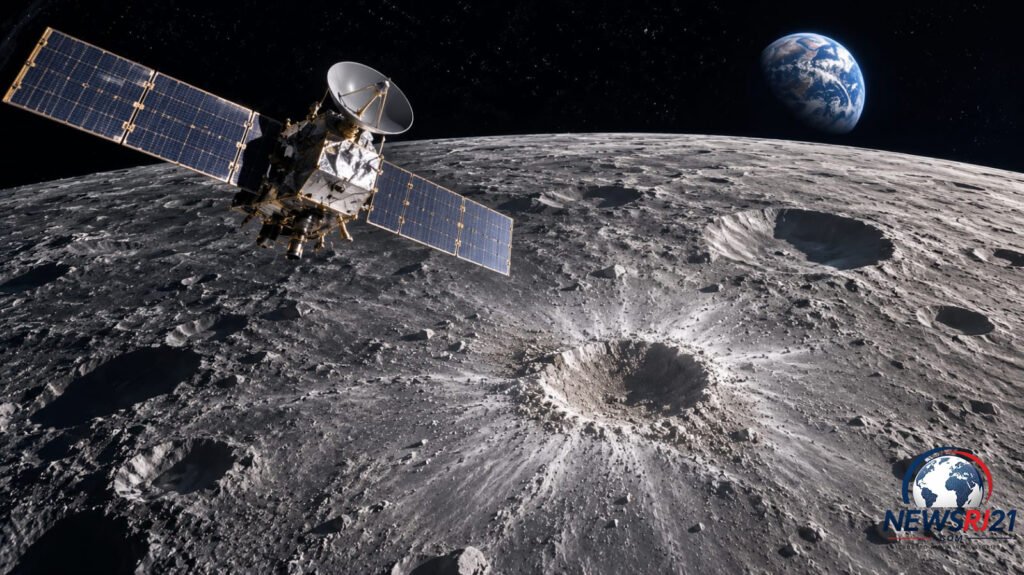
Although the impact itself was not expected to be visible to most people on Earth, scientists are now focused on examining the newly formed crater. The first step is to compare high-resolution images of the impact site taken before and after the collision to measure the crater’s size and analyze the surrounding debris.
NASA’s Lunar Reconnaissance Orbiter (LRO) is expected to photograph the area during upcoming passes over the Moon. South Korea’s Danuri lunar orbiter may also contribute observations, while powerful ground-based telescopes are analyzing data collected during the impact.
Researchers hope the event will reveal how lunar dust is ejected during high-speed collisions, how fresh craters form, and what the exposed material can reveal about the Moon’s geological history. The findings could also improve future impact modeling and mission planning for upcoming lunar exploration programs.
How Much Human-Made Debris Is Already on the Moon?
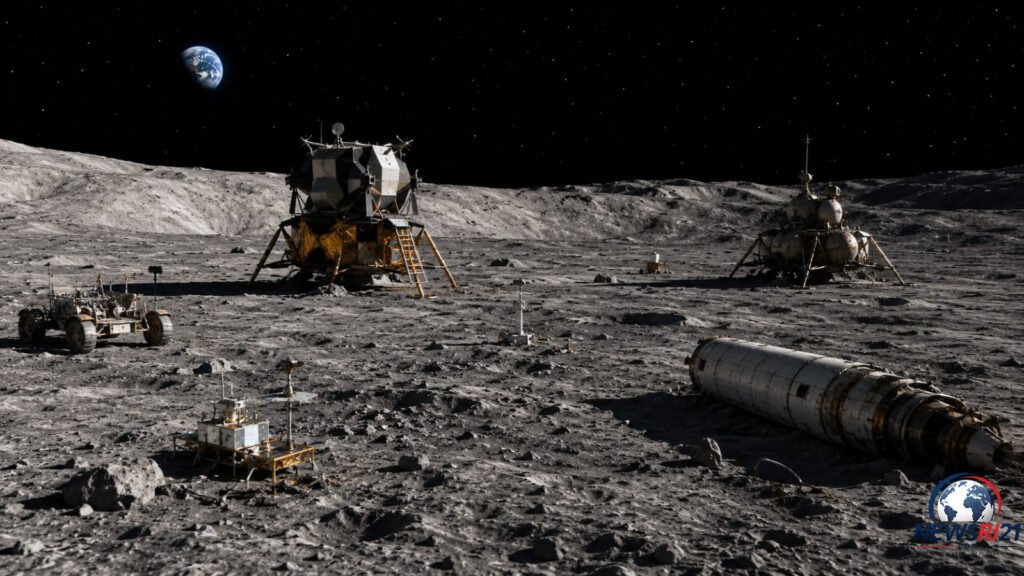
The latest impact has renewed attention to the growing amount of human-made debris on the Moon. Scientists estimate that the lunar surface now contains around 3,000 artificial objects, with a combined weight of roughly 190 tonnes.
The debris includes equipment left behind by the Apollo missions, Soviet Luna spacecraft, Chinese lunar landers, scientific instruments, crashed rocket stages, and hardware from other space missions dating back to 1959, when the Soviet Union’s Luna 2 became the first spacecraft to reach the Moon.
Unlike pollution on Earth, this material does not threaten an ecosystem because the Moon has no atmosphere or biosphere. However, researchers are concerned that increasing debris could interfere with future exploration, disturb historically significant landing sites, and affect untouched regions that preserve billions of years of lunar geological history.
Is the Moon Impact Dangerous?
Scientists say the collision poses no danger to Earth or to people living on the planet. The impact occurred entirely on the Moon, and experts had accurately predicted both the location and timing of the event well in advance.
While the crash created a fresh lunar crater and scattered dust across the surface, there is no atmosphere on the Moon to generate shockwaves or weather-related effects that could affect Earth. Instead, researchers describe the incident as a valuable scientific opportunity rather than a hazardous event.
However, the collision has renewed discussions about the long-term management of space debris. As more government agencies and private companies launch missions to the Moon, scientists believe careful tracking of discarded spacecraft and rocket stages will become increasingly important to reduce risks for future lunar exploration.
What Does This Mean for Future Moon Missions?
As space agencies and private companies prepare for a new era of lunar exploration, experts say the incident highlights the importance of managing space traffic around the Moon. Missions under programs such as NASA’s Artemis and several commercial lunar landers are expected to increase significantly over the coming years.
Scientists are particularly focused on protecting historic landing sites, preserving scientifically valuable regions of the Moon, and reducing the risk of accidental collisions with spacecraft operating in lunar orbit or on the surface.
The Falcon 9 impact is not expected to disrupt any current mission. Instead, researchers believe it offers valuable lessons that could improve spacecraft tracking, mission planning, and debris management as human activity around the Moon continues to expand.
History of SpaceX Falcon 9
Falcon 9 is a reusable two-stage launch vehicle developed by SpaceX to transport satellites, cargo, and astronauts into Earth orbit and beyond. Since its first successful launch in 2010, the rocket has become one of the world’s most frequently used launch systems, supporting missions for NASA, commercial customers, and international partners.
One of Falcon 9’s defining features is its reusable first stage, which can return to Earth and land for future flights, helping reduce launch costs. However, the upper stage is typically not recovered. After completing its mission, it often remains in space, where it may eventually re-enter Earth’s atmosphere or, in rare cases, collide with another celestial body.
The rocket stage involved in the recent Moon impact was launched during a 2025 lunar mission carrying scientific payloads. After completing its primary mission, the upper stage drifted through space before eventually entering an accidental collision course with the Moon, creating a unique scientific opportunity for researchers.
Frequently Asked Questions (FAQs)
Why did the SpaceX Falcon 9 rocket crash into the Moon?
The Falcon 9 upper-stage rocket was left in space after completing its mission in 2025. Over time, its orbit changed naturally, putting it on an accidental collision course with the Moon.
Where did the rocket impact the Moon?
According to NASA and independent astronomers, the rocket struck the lunar surface near Einstein Crater, a large impact basin on the Moon’s far southern region.
Is the Moon collision dangerous to Earth?
No. Scientists have confirmed that the impact poses no threat to Earth. It occurred entirely on the Moon and is considered a valuable scientific event rather than a safety concern.
Why are scientists studying the impact?
Because researchers already knew the rocket’s size, speed, mass, and trajectory, the collision provides a rare opportunity to study crater formation, lunar dust, and the Moon’s surface in greater detail.
How much human-made debris is on the Moon?
Scientists estimate that the Moon now contains around 3,000 human-made objects, including spacecraft, scientific instruments, mission equipment, and discarded rocket hardware from decades of lunar exploration.
Key Highlights
- A SpaceX Falcon 9 upper-stage rocket has crashed into the Moon after drifting through space following a 2025 mission.
- The impact occurred near Einstein Crater at a speed of about 2.43 km/s (5,400 mph).
- Scientists say the collision poses no danger to Earth.
- Researchers know the rocket’s mass, speed, and trajectory, making it a rare scientific experiment.
- NASA’s Lunar Reconnaissance Orbiter (LRO) and South Korea’s Danuri orbiter are expected to study the new impact site.
- The Moon now contains an estimated 3,000 human-made objects, weighing roughly 190 tonnes in total.
- Experts say the event highlights the growing importance of space debris management as lunar exploration accelerates.
Article Summary
A discarded SpaceX Falcon 9 upper-stage rocket has crashed into the Moon near Einstein Crater, creating a rare opportunity for scientists to study a lunar impact under known conditions. Researchers say the event poses no danger to Earth, but it will help improve understanding of crater formation, lunar geology, and the growing challenge of space debris as global lunar exploration continues to expand.
Conclusion
The SpaceX Falcon 9 rocket’s impact on the Moon marks an unusual moment in modern space exploration. While the collision poses no risk to Earth, it provides scientists with a rare opportunity to study the lunar surface under carefully understood conditions. As more missions head toward the Moon in the coming years, the event also serves as a reminder of the growing importance of responsible space debris management and protecting the lunar environment for future exploration.
Sources
- NASA – Center for Near-Earth Object Studies (CNEOS)
- NASA – Lunar Reconnaissance Orbiter (LRO)
- NASA Official Website
- SpaceX Official Website
- BBC News
- University of Cambridge – Institute of Astronomy
- Danuri (Korea Pathfinder Lunar Orbiter) – Korea Aerospace Research Institute (KARI)
Explore More
- Nirmal Purja Dies in Pakistan Avalanche
- FIFA Scraps Controversial World Cup Investment Plan After Global Backlash
- US Launches Massive Airstrikes on Iran